Tree of Knowledge: Mankind's Everlasting Quest for Immortality

In diverse traditions remote in both time and space, the tree is the symbol of the universal life force, that spreads out in manifestation the same way the plant energy spreads from its invisible roots to the trunk, branches, leaves and fruits.
Associated with the tree are superhuman consciousness and immortality, but also destructive forces, mortality and frightening natures such as demons, dragons and serpents. The tree also plays a central role in a whole cycle of theatrical mythological events, in the biblical myth of the fall of Adam and many of its variants.
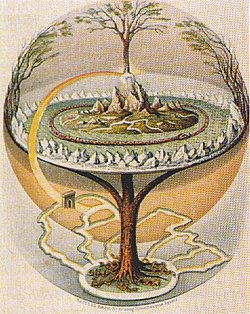
The World Tree across Cultures
The tree as the source of immortality and universal knowledge is not unique to the Bible. We meet the concept of "The World Tree" in many ancient traditions.
- In the Vedas and Upanishads, it is inverted to suggest the source of its power (its roots) is in "the above," in the heavens. From it drips the nectar of immortality (amrita) and in its foliage hides Yama, the goddess of beyond the grave.
- In Iran, we find a double tree. One comprises all seeds, the other produces the drink of immortality (haoma) and is the source of spiritual knowledge. We can think of the trees of Paradise, the Tree of Life and the Tree of Knowledge as the biblical counterparts of the Iranian double tree.
- In the Qabalah, we encounter the great and powerful Tree of Life that elevates life on high. With it is connected a sprinkling by virtue of which the dead are resurrected. This sprinkling is, of course, the equivalent of the Vedic amrita and the Iranian haoma.
- Similar to the above trees, in Assyro-Babylonian mythology, there is a cosmic tree rooted in Eridu, the House of Wisdom.
The Nature of the Tree and the Universal Force
What's common in every ancient tradition is the association of the tree with the Divine Mother.
- The tree becomes the personification of those great Asiatic goddesses of Nature: Anat, Cybele, Ishtar, Tammuz.
- This idea of the feminine nature of the universal force is also corroborated by the goddess consecrated to the Dodona oak, a place of oracles and a fountain of spiritual knowledge in Irish tradition.
- It is also confirmed by the Hesperides, charged with guarding the tree whose fruit has the symbolic value of the Golden Fleece,
- and an immortalizing power that the tree of the Irish Mag Mell legend possesses.
- In the Edda, the goddess Idhunn is charged with the task of guarding the apples of immortality, while in the case of the cosmic tree, Yggdrasil, she becomes a dragon that contains the principle of all wisdom.
- Similarly, in Slavic mythology, we find a saga in which there is an oak on the island of Bajun guarded also by a dragon. This tree is said to be the residence of a feminine principle known as "The Virgin of the Dawn."
- The symbolism is also prevalent in hermetico-alchemical texts. The fountain of Bernard of Treviso is sheltered by a tree in whose center is the dragon Ouroborus that represents the All. It represents the Lady of Philosophers or else the Water of Life that resurrects the dead. Ouroborus stands for a dissolving force, a power that kills and is guarding the Tree of the Sun and the Tree of the Moon that produce crowns in place of fruits.
This tree symbolism is the repository of a supernatural science, a force capable of giving immortality and ultimate knowledge,
but also warns of a multiple danger. It is easy to understand that when
one seeks the conquest of immortality and enlightenment by getting in
touch with this universal force, he must be capable of withstanding
overwhelming grandeur. And so making contact either brings ruin and
damnation for the darer or it transforms him into a god.
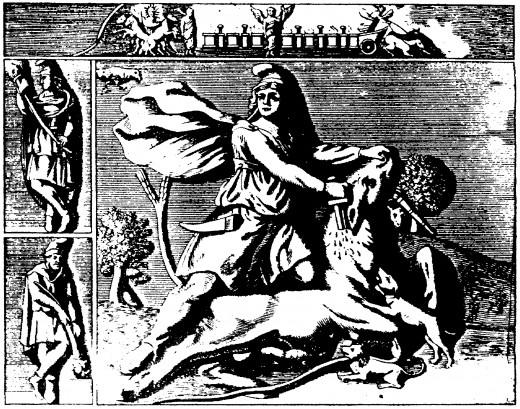
Heroes that conquered the Tree
- Just as Adam uses the power of the tree to acquire its knowledge, Buddha also sits under the tree to attain enlightenment. Although, Adam gets exiled from Paradise for what he has done, he is as successful in his achievement as Buddha is.
- The chief of the Devas, Indra, also appropriates amrita from a linage of anterior beings, the Ashuras.
- Odin, head of the pantheon of Norse gods, by means of hanging himself in sacrifice from the tree Yggdrasil, is also successful in passing its knowledge on to the human race.
- The Roman god Mithras, after fashioning a cloak from the leaves of the tree and eating its fruits, was able to dominate the Sun.
- Nemi, the King of the Woods and husband of a goddess (a tree woman) is the hero of an ancient Italic myth. His power and dignity would pass to whomever could seize and kill him. However, anyone who would attempt this, must first seize a branch of the sacred tree to prove his worthiness of challenging Nemi.
- Similarly, the Hindu tradition talks about the cutting and felling of the Tree of Brahma with the powerful axe of Wisdom.
Heroes that failed
- Agni, the hero of the Vedas, in the form of a hawk manages to snatch a branch of the tree. Unlike Indra, however, he is struck down and his feathers scatter over the earth producing a plant whose sap is the terrestrial soma. This may be an obscure allusion to the passing of the legacy of his deed to another race, now terrestrial.
- For the same deed, that is, passing the knowledge of the gods on to the human race, Prometheus is chained and he has to suffer the torment of the eagle lacerating his innards.
- Jason of the Uranian race, after returning with the Golden Fleece that he found hanging from a tree, dies under the ruins of the Argo, the ship which, having been build of Dodona's oak, conveys the very power that had made the theft possible in the first place.
- In the Eddas, Loki steals the apple of immortality from the goddess Idhunn and is then exiled.
- The Chaldean Gilgamesh, after cultivating the crystalline fruit, finds the entrance blocked by guardians. (Unfortunately, this saga is incomplete, so we don't exactly know what happens to him after.)
- However, the Assyrian god Zu who steals the tables of destiny and so the power of prophetic knowledge, is seized by Baal, made into a bird of prey and exiled.
It is apparent that while some, such as Indra, Odin or Mithras, were successful in gaining the knowledge of the tree, others were not so. The conquest of the tree appears to be an event insolving fundamental risk and uncertainty.
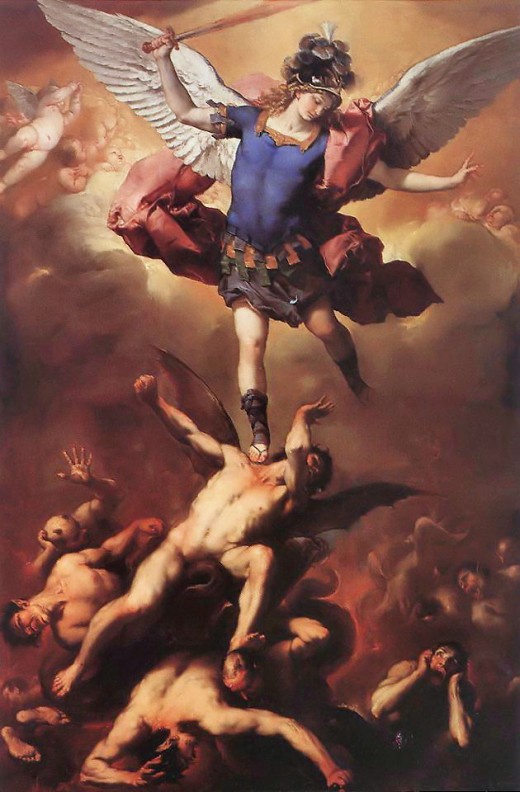
Knowledge of Arts and Crafts and the Fallen Angels
Tertullian
reports that in Arab-Syrian alchemical hermetism, the secrets of
metals, the virtues of plants, the forces of magical conjurations and
the science of the stars were all revealed to men by the fallen angels.
The notion of the B'nai Elohim (fallen angels), who descended (fell) to
Mount Hermon, in the Book of Enoch, is in direct correspondence with
the lineage of Witnesses and Watchers, who came down to instruct
humanity, in the Book of Jubilees.
In the Book of Enoch, Azazel, who seduced Eve,
taught man the use of weapons that kill and so infused in him the
warrior spirit. When we interpret the myth of the fall, that is, "the
angels were seized with desire for women" we should not forget what
'woman' means in connection with the tree.
This notion is further confirmed when we look at the Sanskrit word
shakti which is used to refer to the wife of a god and at the same time
to his power. And it is further confirmed in Tibetan symbolism wherein
wisdom appears as a woman, while method or art plays the part of the
man in coitus with her.
So is it easy to undestand that the
angels were prey to the desire for power and in mating fell to earth.
The powerful race of the Titans, the Nephilims, were born from this
union. They are, in the Book of Baruch, called glorious and warlike.
They awoke in men the spirit of heroes and warriors and invented the
arts. The word root chema, from which alchemy and chemistry derive,
turns up for the first time in order to refer to a tradition of this
kind.
The Will of God
In the biblical myth of the tree, God say,
"The man has become as one of us, to know good and evil; and now, lest he put forth his hand, and take also the tree of life, and eat, and live forever."
In this quote God recognizes the divine dignity of Adam
that he has won, and after that implicitly refers to the possibility of
transferring his achievement to the rank of universal power and
immortality. God, however, did not want this. He wanted to assure the
purpose of the human when he put in him the diverging elements of body
and soul. He did not want the human to live forever, so He imprinted in
him the fear that makes the human submit to His superiority.
About
the domination of the two natures, body and soul, we find in the Corpus
Hermeticum the following words,
"Man loses no worthiness for possessing a mortal part, but very much on the contrary, mortality augments his possibility and his power. His double functions are possible for him precisely because of his double nature: because he is so constituted that it is possible for him to embrace both the divine and the terrestrial at the same time."
No god leaves his sphere to descend to earth whereas man ascends to heaven and measures it. Also,
"The soul of man sees much more deeply than the angels, because it sees as much of heaven as of hell."
And because of that man lives in grave danger in this world.
This is the repost of my hub, Adam, Eve and the Tree of Knowledge, that I wrote using my Pacal Votan avatar.